Some fantasy novels build worlds. Others feel like they remember them.
I’ve written briefly about Patricia Mckillip and specifically her Riddle-Master series before. It’s long been a favorite of mine from childhood and dwells in that personal tier we all have that’s more than something we simply read and liked or even loved, but one of those handful of pieces of art we experience at a specific time that makes you wish you could have run into the author at the airport or something just so you can even if just in passing just let them know how much you appreciated them.
A lot of what I would come to love later as a reader or even just as a human I can see in these books. It may have been my first experience of identifying beautiful prose and thinking to myself there are different ways to get to the same place in writing. When I talked to Catherynne Valente, a more modern stylist I enjoy, we talked about prose, and I feel like the reader in me that appreciated both style and substance, and know that the two are not at odds, probably first found himself with McKillip and as I gravitated to others like China Mieville, Jeff VanderMeer, Meryn Peake, and Rikki Ducornett later in life – writers who every page written, sometimes down to even sentences, were giving us works of art within their art, with novels serving as both a showcase piece and gallery, writer who you didn’t have to wait until you finished a book to have experienced and lived it. It’s the literary journey, not just the destination.
Patricia McKillip though was my first. I remember vividly the day a virgin reader suddenly leveled up when he recognized the beauty of the word.
Patricia A. McKillip’s Riddle-Master trilogy doesn’t unfold like a traditional epic. It drifts toward you like a forgotten song, something half-heard in a dream, or hummed behind a door that hasn’t opened in centuries. You don’t read these books. You tune to them.
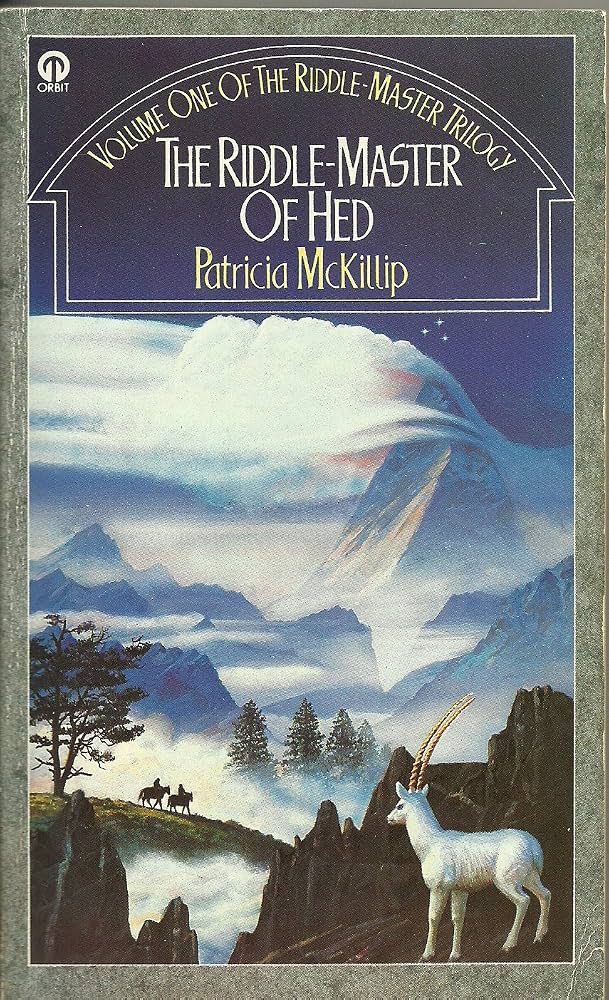
The story begins with The Riddle-Master of Hed and a quiet prince named Morgon, a farmer-born, scholar-minded, marked by three stars on his brow and a pull toward things left unsaid. In this world, riddles aren’t riddles. They’re how history survives. How memory becomes magic. How power is given shape. You don’t solve them. You inherit them.
McKillip doesn’t explain the rules of her world so much as she resonates them. Her prose is spare but luminous, like light caught on water, more breath than sentence. She doesn’t worldbuild in the conventional sense. She world-haunts. The effect is disorienting, and intentional. You’re not guided through a plot; you’re swept into a current of half-remembered lore, where land-laws and long-dead kings still speak. If you know how to listen.
This is fantasy without footnotes. It doesn’t offer scaffolding. It withholds. And the withholding is the point.
What unfolds across Heir of Sea and Fire and Harpist in the Wind isn’t a crescendo of battles or political intrigue, but a deepening of myth, of silence, of identity. Morgon’s journey is not one of conquest but of recognition. The most dangerous knowledge here isn’t forbidden magic. It’s your own name.
Because names in McKillip’s world don’t just identify. They bind. To name something is to become responsible for it. To speak truth is to invite transformation. And to remember, truly, is to risk unraveling.
Here’s where I’ll say the quiet thing out loud: I didn’t understand Riddle-Master the first time I read it. I don’t think I was supposed to. I was too young, too used to books that announced themselves, explained themselves, played fair with plot. But something about it stuck, like the ghost of a tune I couldn’t name. Years later, I found it again, and this time, it opened. Or maybe I did. It’s hard to tell. All I know is that some books wait for you. And when they recognize you, you feel it.
There are echoes of Earthsea here, especially in the moral gravity of language, or The Silmarillion, in the weight of ancient grief. But McKillip is softer, stranger. Less interested in scaffolding than in atmosphere. She doesn’t deliver lore. She whispers the ruins of it.
Even now, decades later, the Riddle-Master books feel untouched by time, neither modern nor retro, just quietly eternal. McKillip, who passed in 2022, never chased sequels or trilogies for the sake of market rhythms. Each of her books is a standalone spell. But this one? This is the first chord. And the deepest.
Riddle-Master doesn’t satisfy in the usual way. It lingers. It flickers. It changes shape behind your back. If you’re looking for answers, it won’t give you any. But if you’re willing to sit in the question, it will remember something for you.
Something you didn’t realize you’d forgotten.
Thanks Pat.